Wet Kitchen vs Dry Kitchen in Malaysia (2026): Cost, Layout & What Most Homeowners Get Wrong
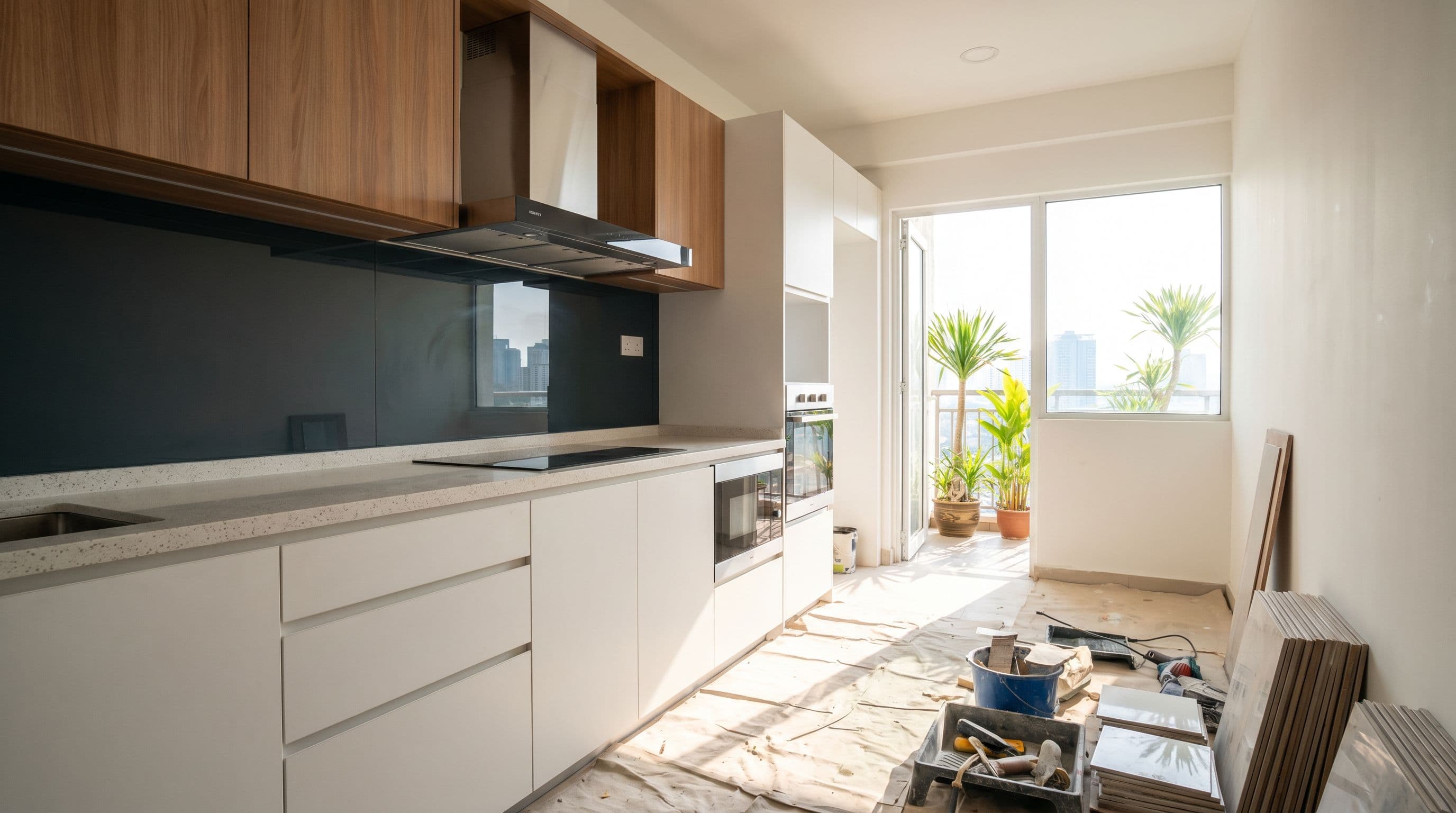
Walk into any Pinterest-perfect kitchen and you'll see one big open island, exposed shelves, and a single elegant cooktop. Bring that exact layout into a Malaysian home and within six months your walls turn yellow, your sofa smells like sambal, and your contractor is shrugging while you ask why.
That's because the global "open kitchen" model doesn't account for how Malaysians actually cook. Heavy frying, ikan bilis, curries, stir-frying with high heat — these produce grease, smoke, and smells that destroy a single open kitchen. Which is exactly why Malaysian homes evolved the wet kitchen plus dry kitchen split. It's one of the most distinctly local design decisions in any renovation, and it's also the one most foreign blogs, YouTube videos, and IKEA-inspired Pinterest boards completely miss.
This guide is about doing the wet/dry split properly in 2026. We'll cover what each kitchen actually does, the real cost difference between them, the sizing and layout rules nobody writes down, the material decisions that quietly ruin most wet kitchens, and the five mistakes Malaysian homeowners make that turn a smart layout into a daily annoyance.
Why Malaysian Kitchens Are Split in the First Place
Climate, Cuisine, and a Layout That Actually Works
The wet/dry kitchen split exists because Malaysian cooking is fundamentally different from the cooking that informs most modern kitchen design. Western kitchens evolved around oven baking, light pan-frying, and minimal aerosolized oil. Malaysian cooking centres on high-heat wok stir-frying, deep-frying, sambal-making, and slow-simmered curries — all of which throw grease, smoke, and strong aromas into the air for hours at a time.
In a single open kitchen, that grease coats your fabric sofa, settles into your curtains, yellows the ceiling above your hob, and lingers on every surface in your living room. Walk into the wet kitchen of any well-loved Malaysian home and you'll see why we don't do this in the same room as the dining table.
The split also matches how Malaysian families actually live:
Wet kitchen (dapur basah) is the working room. Heavy cooking, messy prep, deep cleaning. It's typically tucked at the back, with proper ventilation, full-height tiles, and floors built to be hosed down. Many homes can completely close it off behind sliding doors when not in use.
Dry kitchen (dapur kering) is the social room. Coffee in the morning, breakfast prep, baking, plating, entertaining. It often opens directly to the dining or living area and prioritizes appearance — island counters, pendant lights, feature backsplashes, sometimes a wine cooler or coffee station.
Once you understand this split as a functional decision rather than a design fashion, every other choice (size, materials, ventilation, layout) becomes much clearer.
The Cost Difference Between a Wet Kitchen and a Dry Kitchen
Why They Don't Cost the Same Per Square Foot
The two kitchens look like the same room on a floor plan, but they cost very different amounts to renovate properly.
Wet kitchen renovation cost in Malaysia (2026):
- Budget: RM7,000 to RM12,000
- Mid-range: RM12,000 to RM22,000
- Premium: RM22,000 to RM40,000+
Dry kitchen renovation cost in Malaysia (2026):
- Budget: RM5,000 to RM10,000
- Mid-range: RM10,000 to RM20,000
- Premium: RM20,000 to RM45,000+
At first glance, the dry kitchen looks cheaper. But once you start adding islands, pendant lighting, fluted-glass cabinets, and feature stone, the dry kitchen quietly becomes the more expensive of the two for many homeowners.
Where the wet kitchen spends its money:
- Heavy-suction hood (1,200 to 2,000 m³/hr): RM1,800 to RM4,500. Cheap hoods can't keep up with Malaysian wok cooking; the smoke goes into your house instead of out of it.
- Wet-rated cabinet carcass (aluminium frame or marine plywood): 30% to 50% more than melamine particle board, but mandatory if you want it to last.
- Heavy-duty stainless steel sink, often double-bowl: RM800 to RM2,500.
- Full-height wall tiles to ceiling: RM800 to RM2,500 extra over half-height.
- Stronger gas line, additional ventilation provisions, and properly graded floor for hosing down.
Where the dry kitchen spends its money:
- Island counter or breakfast bar: RM3,500 to RM12,000. The single biggest dry-kitchen line item.
- Premium door finishes (acrylic, lacquer, fluted glass): 50% to 200% more than melamine.
- Pendant lighting and feature wall treatments.
- Optional add-ons: integrated coffee station, wine fridge, decorative shelving, banquette seating.
The combined reality for a Malaysian condo with both:
Mid-range tier lands at RM18,000 to RM35,000 combined. Premium lands at RM35,000 to RM65,000+. Smaller condos under 800 sqft often only have a wet kitchen plus a small breakfast counter — that simplifies things and reduces the combined cost by 25% to 35%.
Sizing and Layout: How Big Should Each Kitchen Actually Be?
The Proportions That Make Sense for Real Malaysian Cooking
One of the most common mistakes Malaysian homeowners make is getting the proportion wrong between wet and dry kitchens. The dry kitchen ends up bigger because it looks nicer in 3D renders, while the wet kitchen — where the actual cooking happens daily — gets cramped to the point of being unusable.
Practical sizing rules for 2026:
Wet kitchen sizing:
- Minimum useful size: 35 to 45 sqft. Below this, two people can't move past each other while cooking.
- Comfortable size for daily use: 50 to 70 sqft.
- Generous: 70 to 100 sqft, allows a full L-shape with room to manoeuvre.
- Counter run: at least 8 to 10 linear feet, ideally with the hob, sink, and prep area in the classic kitchen triangle.
Dry kitchen sizing:
- Minimum useful size: 30 to 40 sqft if it's just a galley.
- With a small island: 60 to 80 sqft.
- With a full island and seating: 80 to 120 sqft.
For a typical Malaysian condo (900 to 1,200 sqft total):
The right ratio is usually 60% wet, 40% dry — or even closer to 50/50 if the family cooks Malaysian food daily. Most homeowners default to 40/60 (wet/dry) because the dry kitchen renders look cooler. They regret it within two months of moving in.
Layout patterns that work in Malaysia:
1. Wet at the back, dry opening to dining: The most common and most flexible. Sliding glass doors between them keep grease out while letting light in. Works for 90% of condos and terrace houses.
2. Wet behind a full wall, dry as the visible "show kitchen": Common in larger landed homes. The wet kitchen becomes a dedicated workhorse room; the dry is purely for plating and entertaining.
3. Single kitchen with a heavy-duty hood: Acceptable for households that don't do heavy frying or curries (rare in Malaysia). Saves space but you lose grease-management flexibility.
Avoid these layouts:
- Wet kitchen with no door or partition to the dining area. Your home will smell like dinner for the rest of the night.
- Dry kitchen island so big it leaves under 800mm of clearance on each side. You can't open dishwasher and oven doors at the same time.
- Wet kitchen tucked into a 30 sqft corner just so the dry kitchen can have an island. You'll cook in the dry kitchen anyway, defeating the entire purpose of the split.
Material Decisions: Why the Wet Kitchen Needs Different Stuff
The Specs That Quietly Decide How Long Your Kitchen Lasts
The materials in the dry kitchen can be whatever looks best within your budget. The wet kitchen has actual functional requirements that you can't ignore without paying the price in two to four years.
Cabinet carcass for the wet kitchen:
- Particle board / chipboard: do not use. Swells from steam and the small water leaks that inevitably happen behind a sink. Lifespan in a real Malaysian wet kitchen: 4 to 6 years.
- Marine-grade plywood (BB-grade, 18mm): the standard for serious renovations. RM280 to RM450 per linear foot. Lifespan 12 to 20 years.
- Aluminium frame: RM380 to RM550 per linear foot. Won't warp, won't attract termites, easy to wipe down. Slightly cold aesthetic but extremely practical.
- Stainless steel: RM550 to RM900 per linear foot. Restaurant-grade durability. Worth it for households that cook daily and don't mind the industrial look.
Cabinet carcass for the dry kitchen:
- Particle board with melamine doors is genuinely fine here. RM150 to RM250 per linear foot. The dry kitchen doesn't see meaningful water exposure.
- Plywood is still preferred for longevity, but the marginal benefit is much smaller than in the wet kitchen.
Countertop for the wet kitchen:
- Quartz (RM350 to RM650/running foot): the Malaysian standard. Stain-resistant, no sealing needed. Just don't put very hot pots directly on it.
- Stainless steel: indestructible, scratches into a patina you'll either love or hate.
- Sintered stone (Dekton, Lapitec): heat-proof, indestructible. RM550 to RM1,200/running foot. Worth it for heavy daily cooking.
- Marble: do not use. Etches from acidic foods. Stains permanently from turmeric and tomato.
Countertop for the dry kitchen:
- Anything you want, including marble or solid surface. The dry kitchen rarely sees acidic or staining foods.
Tiling for the wet kitchen:
- Full-height wall tiles to ceiling. Half-height looks cheap and grease ends up on painted walls.
- Floor tiles must be slip-rated (R10 minimum). Polished tiles in a wet kitchen are dangerous.
- Floor must be graded (sloped) toward a floor trap so water can drain when you hose it down.
Ventilation for the wet kitchen:
This is the spec most homeowners get wrong. A 1,200 m³/hr hood is the bare minimum for Malaysian cooking. 1,500 to 2,000 m³/hr is what serious home cooks should aim for. Cheap 800 m³/hr hoods exist but they're for kitchens that mainly do light Western-style cooking. The hood ducting also matters: shorter, straighter ducting is dramatically more effective than long bendy runs through ceiling soffits.
The 5 Most Common Wet/Dry Kitchen Mistakes
What People Regret Within Six Months of Moving In
Across hundreds of Malaysian homes, the same handful of mistakes show up over and over. Avoid these and your kitchen will outlast your renovation loan.
Mistake #1: Making the dry kitchen too big and the wet kitchen too small.
Driven by 3D renders that prioritize aesthetics. The wet kitchen is where you'll spend 90% of your actual cooking time — and you'll resent every cramped move you make in it for the next decade. Fix: insist on at least 50 sqft for the wet kitchen before allocating space to the dry.
Mistake #2: Underspecifying the hood.
Saving RM2,000 by choosing a 600 m³/hr hood means RM5,000 worth of yellowed ceiling, soiled curtains, and grease-coated walls within two years. Fix: minimum 1,200 m³/hr for any household that cooks daily, with a duct run no longer than 4 metres total.
Mistake #3: Using the same cabinet material for both kitchens.
Most quotations bundle "kitchen cabinets" as one line. The wet kitchen quietly gets cheap melamine particle board, swells from a pinhole leak under the sink, and the cabinet doors fall off in year four. Fix: explicitly specify carcass material per kitchen — plywood or aluminium for wet, melamine or plywood acceptable for dry.
Mistake #4: No partition between wet kitchen and the rest of the home.
A "modern open layout" with a wet kitchen open to the dining room means your sofa smells like sambal. Permanently. Fix: at minimum, sliding glass doors. Ideally, full sliding partition with a proper seal at the bottom. Even a simple curtain helps if the budget is tight.
Mistake #5: Treating the dry kitchen as decoration rather than working space.
Glamorous islands with no power points, beautiful cabinets that don't actually fit a coffee machine, no proper task lighting over the prep area. Fix: design the dry kitchen for at least 4 to 6 power points (kettle, toaster, blender, coffee machine, microwave, charging), under-cabinet task lighting, and at least 2 metres of usable counter run.
Do You Actually Need Both? The Small-Condo Question
When the Hybrid Layout Makes More Sense
Not every Malaysian home has space for two kitchens. For condos under 850 sqft, the wet/dry split can leave you with two undersized rooms that don't work properly as either.
When the full wet/dry split makes sense:
- Total kitchen area available: 80 sqft or more.
- You cook Malaysian food more than three times a week.
- You entertain regularly (the dry kitchen becomes the social space).
- Your home opens kitchen to dining/living without a corridor between them.
When a hybrid layout works better:
- Total kitchen area: 50 to 80 sqft.
- Daily cooking is mostly light (Western breakfast, simple lunches, occasional dinner).
- You're optimising for resale value over personal preference.
The hybrid layout in practice:
A single kitchen with a heavy-duty hood (1,500 m³/hr+), a small breakfast counter or peninsula extending into the dining area, and a sliding partition that closes when you do heavy cooking. Cost: RM18,000 to RM32,000 for a typical condo. You give up the dedicated dry kitchen aesthetic but gain a much more usable single workspace.
The "yard kitchen" alternative:
Many Malaysian condos have a service yard adjacent to the main kitchen. A common 2026 move is to convert that yard into a small wet kitchen (8 to 12 sqft) with a single hob, hood, and sink, and keep the main kitchen as the dry/show kitchen. This works surprisingly well if the yard already has gas, water, and ventilation. Cost: RM6,000 to RM12,000 for the yard wet kitchen on top of your dry kitchen renovation.
When to skip the wet kitchen entirely:
Households that genuinely don't do heavy Malaysian cooking — small couples who eat out most days, retirees with minimal cooking — can get away with a single well-ventilated kitchen and a good hood. But be honest about how you cook now, not how you imagine you'll cook in the future. Most aspirations to "cook more healthy meals at home" don't survive year one.
How to Brief Your Contractor on the Wet/Dry Split
The Specific Language That Avoids Misunderstandings
Most contractors will assume you want a default layout unless you tell them otherwise. Be specific in your brief and you'll get much better quotations.
At the design stage, communicate:
- Cooking style: "We cook Malaysian food 4 to 5 times a week, including frying and curries." This single sentence tells the contractor your hood, ventilation, and material specs need to be serious.
- Wet/dry split intent: "I want a separate wet kitchen and dry kitchen, with sliding doors between them. Wet kitchen at minimum 55 sqft, dry kitchen with a small island and breakfast counter." The earlier you say this, the more thoughtful the layout.
- Partition type: Be specific. "Sliding aluminium-frame glass doors between the two, full height to ceiling, with a sealed bottom track."
In the quotation, demand line items per kitchen:
- "Wet kitchen cabinet — plywood carcass, melamine doors, RM[X] for [Y] linear feet."
- "Dry kitchen cabinet — plywood carcass, fluted glass aluminium doors, RM[X] for [Y] linear feet."
- "Wet kitchen countertop — quartz, brand [X], series [Y], 20mm slab, RM[X] for [Y] running feet."
- "Dry kitchen countertop — solid surface, brand [X], RM[X]."
Specs to insist on in writing:
- Hood model number and m³/hr rating (not just "branded hood")
- Cabinet plywood thickness (18mm marine grade is the proper standard)
- Tile coverage zones (full-height for wet kitchen wall behind hob and sink)
- Floor slope direction in the wet kitchen toward a defined floor trap
- Power point count and locations per kitchen (for both wet and dry)
On site visits, check:
- The hood ducting actually goes outside the building, not just into a ceiling void. This is a real issue in older condos.
- The wet kitchen floor visibly slopes toward the floor trap (you can pour water and watch where it goes).
- The cabinet under the sink has been treated for water resistance, not just laminated like the others.
You can browse verified kitchen renovation contractors in Malaysia on FindContractor.my, request multiple quotations with the line-item structure above, and compare answers from contractors who genuinely understand the wet/dry split.
Real Trade-offs: What Malaysian Homeowners Actually Optimise For
Choosing Between Aesthetic, Function, and Budget
In a perfect world you'd have 100 sqft of wet kitchen, 100 sqft of dry kitchen, sintered stone everywhere, and a 2,000 m³/hr hood. In real Malaysian homes, you'll have to choose. Here's how to choose well.
If your budget is tight (RM18,000 to RM25,000 total):
Spend most of it on the wet kitchen — proper plywood cabinets, decent quartz, a real hood. Keep the dry kitchen as a simple breakfast counter with melamine doors and basic tiling. The wet kitchen does the actual work; the dry kitchen can be upgraded later.
If your budget is mid-range (RM30,000 to RM45,000 total):
Get both kitchens to a solid standard. Plywood + acrylic for both. Quartz for both. A 1,500 m³/hr hood. Sliding glass partition. Skip the marble and the imported European appliances. This is the sweet spot for most Malaysian families.
If your budget is generous (RM50,000+):
Now you can think about sintered stone in the wet kitchen, a proper island in the dry kitchen, integrated appliances, and high-spec hardware (Blum hinges, soft-close drawers throughout). At this level, the marginal upgrades start losing real-world value — you're paying for aesthetics and convenience, not function.
If you're optimising for resale:
Buyers in 2026 expect a wet/dry split in any condo above 1,000 sqft and any landed home. Skipping the split limits your buyer pool. But buyers don't care about premium materials — they want a clean, functional layout. Mid-range materials with a smart wet/dry split sell better than premium materials with a cramped single kitchen.
If you're optimising for daily use:
Spend on the hood, the cabinet carcass, and the wet kitchen layout. Skimp on door finishes (you can replace them in 8 years), feature backsplashes, and the dry kitchen island. The things that affect cooking enjoyment every single day are the things worth paying for.
Final Thoughts
The wet/dry kitchen split is one of the smartest local design decisions in any Malaysian home, and it's also one of the easiest to mess up. Get the proportions wrong and you'll have a beautiful dry kitchen you barely use and a cramped wet kitchen you resent every day. Get the materials wrong in the wet kitchen and you'll be replacing cabinets in year four. Get the partition wrong and your sofa will smell like sambal.
The good news: none of this is expensive to do right. A well-planned wet/dry split with proper plywood carcass, a real hood, decent quartz, and a sliding glass partition lands at RM25,000 to RM40,000 for most Malaysian condos. That's the same money many homeowners spend on a single open kitchen they end up unhappy with.
Brief your contractor specifically. Insist on line-by-line quotation per kitchen. Spend on the hood, the wet kitchen carcass, and the partition. Save on the dry kitchen island, the marble feature wall, and the imported European appliances unless they truly matter to you.
Browse verified kitchen renovation contractors in Malaysia on FindContractor.my to compare quotations from contractors who actually understand the wet/dry split. If you're planning a full home renovation or working with interior design companies instead, we cover those directories too.
Frequently Asked Questions
What is the difference between a wet kitchen and a dry kitchen in Malaysia?
A wet kitchen (dapur basah) is the working kitchen used for heavy Malaysian cooking — frying, stir-frying, curries, and sambal — and is built with grease-resistant materials, heavy-suction hoods, and full-height tiles. A dry kitchen (dapur kering) is the lighter prep and entertaining space used for breakfast, coffee, baking, and plating, typically opening to the dining or living area with islands and feature lighting. The split exists because Malaysian-style high-heat cooking produces grease and aromas that would otherwise coat an open kitchen and adjacent living areas.
How much does a wet kitchen renovation cost in Malaysia in 2026?
A wet kitchen renovation in Malaysia (2026) costs RM7,000 to RM12,000 for budget, RM12,000 to RM22,000 for mid-range, and RM22,000 to RM40,000+ for premium. The main cost drivers are a heavy-suction hood (1,200 to 2,000 m³/hr at RM1,800 to RM4,500), wet-rated cabinet carcass (marine plywood or aluminium at RM280 to RM550 per linear foot), heavy-duty sink (RM800 to RM2,500), and full-height wall tiles (extra RM800 to RM2,500 over half-height tiling).
How much does a dry kitchen renovation cost in Malaysia?
A dry kitchen renovation in Malaysia (2026) costs RM5,000 to RM10,000 for budget, RM10,000 to RM20,000 for mid-range, and RM20,000 to RM45,000+ for premium. The biggest line item is usually the island counter or breakfast bar (RM3,500 to RM12,000). Dry kitchens also spend more on premium door finishes (acrylic, lacquer, fluted glass), pendant lighting, and feature wall treatments since the dry kitchen is the visible "show" space.
How big should the wet kitchen and dry kitchen be in a Malaysian home?
For most Malaysian condos, the wet kitchen should be at least 50 to 70 sqft (minimum 35 to 45 sqft), and the dry kitchen 30 to 80 sqft depending on whether it has an island. The right ratio is typically 60% wet and 40% dry — or closer to 50/50 for households that cook Malaysian food daily. Many homeowners default to making the dry kitchen bigger because it looks better in renders, but the wet kitchen is where most actual cooking happens.
Do I really need both a wet and dry kitchen in my condo?
Yes if your total kitchen area is 80 sqft or more, you cook Malaysian food more than three times a week, or you entertain regularly. For smaller condos under 850 sqft or households that mainly do light Western-style cooking, a hybrid layout (single kitchen with a heavy-duty 1,500 m³/hr+ hood plus a small breakfast counter and sliding partition) usually works better. Some condos also use the service yard as a small wet kitchen while keeping the main kitchen as the dry kitchen.
What kind of hood do I need for a Malaysian wet kitchen?
A minimum 1,200 m³/hr hood is the bare minimum for any household that cooks Malaysian food regularly. For serious daily cooks, aim for 1,500 to 2,000 m³/hr. Cheaper 600 to 800 m³/hr hoods cannot keep up with high-heat wok cooking and result in grease coating walls, ceilings, and curtains within two years. Equally important: the duct run must be short and direct (under 4 metres total, minimal bends) and must vent outside the building, not into a ceiling void.
What materials should I use for a Malaysian wet kitchen?
For the wet kitchen, use marine-grade plywood (BB-grade, 18mm) or aluminium-frame cabinet carcass — never particle board or chipboard, which swell from steam and minor water leaks within 4 to 6 years. Use quartz, stainless steel, or sintered stone for countertops; avoid marble (etches from acidic foods like turmeric and tomato). Use full-height wall tiles to ceiling, R10 slip-rated floor tiles, and a graded floor sloping toward a floor trap. The dry kitchen has lighter requirements and can use particle board with melamine doors.
Related Articles


Ready to Start Your Project?
Get quotes from verified contractors, or browse reviews and transparent pricing on FindContractor.