Bathroom Leaking Into the Unit Below? Waterproofing Cost and Fixes in Malaysia (2026)
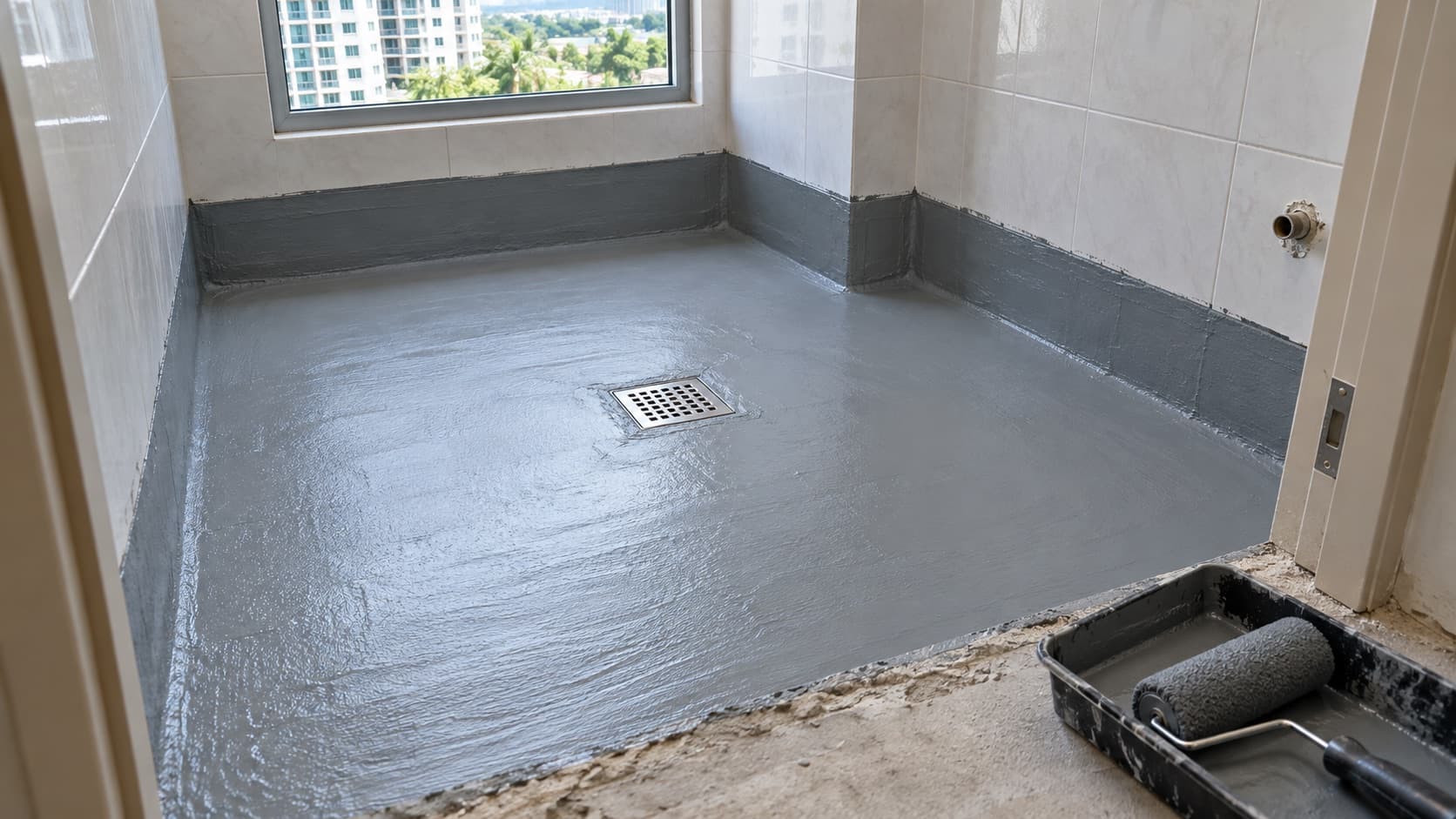
The message from your downstairs neighbour usually arrives with a photo: a brown stain on their bathroom ceiling, a bubble in the paint, sometimes a steady drip into a pail. Your bathroom looks perfectly fine from above. That is the problem with waterproofing. It sits under the tiles, nobody sees it, and you only find out it failed when the water has already travelled through the slab.
Here is the short answer. As a rough Klang Valley guide, waterproofing cost in Malaysia runs from about RM650 for a no-hack ceiling injection, to RM1,500 to RM5,000 to hack, re-waterproof and retile a typical bathroom, to RM5,000 to RM20,000 for a flat roof. Which one you need depends on where the water is actually coming from, and that is the step most homeowners skip.
This guide covers what each fix costs, how to find the real source before you pay for anything, when injection is enough and when it is money down the drain, and, for condo owners, exactly who has to pay under the strata leakage rules.
What Waterproofing Costs in Malaysia (2026 Estimates)
The ranges below are indicative Klang Valley market prices published by ClickBina's waterproofing cost guide (updated May 2026), not fixed rates. Prices vary with access, how much has to be hacked, the system used, and the condition of the slab underneath. Treat them as a sense check against the quotes you receive, not as a price to demand.
One thing that confuses people: our bathroom renovation cost guide lists waterproofing at RM600 to RM1,500. That is the membrane alone, as one line item inside a renovation where the tiles are coming off anyway. A repair costs more because you are also paying to hack out good tiles, dispose of the debris and retile.
- •No-hack ceiling injection (bathroom): flat rates around RM650, often with a short warranty, such as 6 months.
- •PU injection by point: around RM80 to RM250 per injection point. The contractor decides the number of points on site, so 15 points can easily pass RM3,000.
- •Non-hacking bathroom package: around RM2,500.
- •Hack, re-waterproof and retile a bathroom: around RM1,500 to RM5,000 for 50 to 80 sqft, roughly RM2,000 to RM4,000 for a mid-spec 60 sqft bathroom.
- •Balcony or yard (tiled): around RM800 to RM3,000.
- •Planter box: around RM600 to RM1,800.
- •Flat roof or roof terrace: around RM5,000 to RM20,000 for 200 to 600 sqft.
- •Membrane rates per sqft (supply and apply): cementitious RM8 to RM14, liquid polyurethane (PU) RM12 to RM20, torch-on bitumen RM10 to RM18.
- •Minimum job charge: commonly RM500 to RM800, so even a tiny repair is rarely cheaper than that.
Find the Source Before You Pay for a Fix
Not every ceiling stain is a failed waterproofing membrane. A leaking supply pipe, a cracked floor trap, a gap around a pipe that passes through the slab, or an aircon drain can all leave the same mark on the ceiling below. If you pay for new waterproofing when the real problem is a pipe, you will have a beautiful new bathroom and the same leak.
When it leaks is the best clue, and you can check most of this yourself in an afternoon:
- •Only after someone showers: points to the floor membrane, the floor trap, or grout and tile joints in the shower area.
- •All the time, even when the bathroom is not used: points to a pressurised supply pipe. Turn off every tap in the unit and watch the water meter. If it still moves, you have a pipe leak, not a waterproofing problem.
- •Only when it rains: points to the roof, an external wall, a window frame or a balcony, not the bathroom.
- •Only when the aircon runs: check the aircon drain pipe before anything else.
- •A flood test settles it: block the floor trap, fill the bathroom floor with a few centimetres of water and leave it for 24 to 48 hours while someone watches the ceiling below. A good contractor will do this before quoting a major job.
No-Hack Injection vs Hack and Redo
Injection is tempting. It is quicker, cheaper, and nobody has to rip out tiles. The contractor drills small holes from the ceiling below or through the grout lines above and pumps in PU or epoxy to seal the path the water is taking.
The catch is that injection seals the path the water is taking today. If the membrane underneath has failed across the whole floor, the water finds a new path, and you are back to a stain a few months later. That is why injection packages often come with warranties measured in months, while a full hack-and-redo should come with a warranty measured in years.
A simple way to decide:
- •Injection can make sense for a single, localised leak point, a bathroom renovated recently with a known small defect, or as a stop-gap while you plan a proper renovation.
- •Hack and redo makes more sense when the leak has come back after a previous injection, when stains appear in several spots, when the bathroom is old and you were going to renovate anyway, or when the tiles themselves are hollow or cracked.
- •Ask for the warranty in writing either way, with its length and what it covers. A RM650 injection with a 6-month warranty and a RM3,500 redo with a multi-year warranty are not the same product at different prices.
Condo Owners: Who Pays When a Bathroom Leaks Into the Unit Below
Strata Management (Maintenance and Management) Regulations 2015
In a strata building, the rules for this situation are written down in Part XV of the Strata Management (Maintenance and Management) Regulations 2015, regulations 55 to 64. They call it "inter-floor leakage", and the process runs through your JMB or MC, not a shouting match in the lift lobby.
The presumption is against the unit above. Under section 142 of the Strata Management Act, the defect is presumed to be in the parcel above the affected one until shown otherwise. But the regulations also split responsibility by what is leaking:
- •The affected owner (below) gives notice to the JMB, MC or, during the developer management period, the developer.
- •Management must inspect within seven days of receiving the notice to find the cause and the party responsible.
- •Within five days of the inspection, management issues a certificate of inspection in Form 28 stating the cause and who must fix it.
- •A pipe that serves only one unit is that unit's problem, even if it runs through common property or the ceiling void. A pipe that serves more than one unit is common property, which management fixes.
- •The responsible owner has seven days from receiving Form 28 to fix it. If they do not, management must carry out the repair and recover the cost from them.
- •Access is required by law. With seven days' written notice, an owner who refuses access for inspection commits an offence carrying a fine of up to RM50,000, up to three years' imprisonment, or both. In an emergency, notice is not needed.
- •Disagree with the finding? Either side can refer it to the Commissioner of Buildings (COB), who can appoint a registered engineer or other professional at the responsible party's cost.
Still Within the Defect Liability Period? Call the Developer First
If the leak appears in a newly completed home, check your sale and purchase agreement before you spend a sen. For residential properties sold under the standard Schedule G and H agreements, the developer must repair defects reported within the defect liability period of 24 months from vacant possession (EdgeProp's guide to the defect liability period explains how it works).
The strata regulations say the same thing for leaks: a leak during the defect liability period caused by defective workmanship or materials is the developer's responsibility. Report it in writing, with photos and dates, and keep a copy.
Two warnings. First, if you hack the bathroom yourself before the developer inspects it, you may lose the ability to prove it was their defect. Second, some commercial-titled units such as SOHOs and serviced apartments may not use the regulated Schedule G or H agreement, so read what your own SPA says.
What a Proper Waterproofing Job Includes
Waterproofing is the most frequently cut corner in bathroom work, because once the tiles are on, nobody can see it. You cannot inspect it after the fact, so you have to ask about it before the fact. A proper job, for a bathroom in particular, should include:
- •Removal of the old tiles and failed membrane down to a sound, clean surface, not a new membrane painted over old problems.
- •Repair of cracks and a properly sloped screed so water runs to the floor trap instead of sitting in a corner.
- •Extra reinforcement at the weak spots: the corner where wall meets floor, around the floor trap, and around every pipe that goes through the slab. Most leaks start at these junctions.
- •The membrane carried up the walls in the shower area, not just across the floor.
- •The coats and curing time the product requires before tiling. A contractor who tiles the same day is not following the product instructions.
- •A flood test of 24 to 48 hours before tiling, with the ceiling below checked. This is the only chance to catch a failure while it is still cheap to fix.
- •A written warranty naming the waterproofing system used and how long it is covered.
Roofs, Balconies and Planter Boxes
Rain-related leaks are a different job from bathroom leaks and often a different contractor. For flat concrete roofs, torch-on bitumen membrane and liquid PU membrane are the two common systems. Torch-on sheets are heat-bonded and suit large flat roofs; liquid PU suits roofs with lots of corners, pipes and edges, since it goes on without seams. Acrylic roof coatings are cheaper, but they are a protective top layer for a roof that is still sound, not a fix for one that already leaks.
Balconies and planter boxes fail for the same reasons bathrooms do: a poor slope, an unsealed drain outlet, or a membrane that stopped short of the wall. Planter boxes are a classic culprit in terrace houses and condos alike, because roots and constant damp punish any weak spot. If you have a planter box built against a wall with damp patches on the other side, start your investigation there.
For roof leaks on pitched roofs with tiles or metal sheets, the cause is usually cracked or shifted tiles, rusted sheets, or failed flashing rather than waterproofing, so speak to a roofing contractor instead.
Questions to Ask Before You Accept a Waterproofing Quote
A waterproofing quote that says only "waterproofing works, RM3,500" tells you almost nothing. Ask these questions, and get the answers in writing. If you are comparing several quotes, our guide on how to read and compare renovation quotations shows how to line them up item by item.
- •What do you think is causing the leak, and how did you confirm it?
- •Which waterproofing system and product will you use, and how many coats?
- •Is the area being hacked, and does the price include disposal, new tiles and retiling?
- •How will you treat the floor trap, the wall-floor corners and the pipe penetrations?
- •Will you do a flood test before tiling, and for how long?
- •How long is the warranty, what does it cover, and what voids it?
- •If the injection does not stop the leak, is a return visit included or charged?
Final Thoughts
Waterproofing is cheap to do right and expensive to do twice. Find the source first: shower-related, pipe-related, rain-related, or aircon. Choose injection only for a localised leak you understand, and choose a proper hack and redo when the membrane has failed. Insist on a flood test before the tiles go back on, and a written warranty that names the system.
If you live in a condo and a leak is coming from above, do not argue with your neighbour. Give written notice to your JMB or MC and let the seven-day inspection and Form 28 process do its job. If you are the unit above, cooperating early is far cheaper than waiting for management to fix it and send you the bill.
When you are ready, browse waterproofing contractors on FindContractor, compare their reviews, or get free quotes from verified contractors. If the bathroom needs more than waterproofing, our bathroom contractors and 7 tile mistakes guide are a good next step.
Frequently Asked Questions
How much does bathroom waterproofing cost in Malaysia?
As a rough Klang Valley estimate for 2026, a no-hack ceiling injection starts around RM650, a non-hacking package is around RM2,500, and hacking, re-waterproofing and retiling a typical 50 to 80 sqft bathroom costs around RM1,500 to RM5,000. Inside a full renovation where tiles are already coming off, the membrane alone is usually a smaller line item.
My bathroom is leaking into the condo below. Do I have to pay?
Under the Strata Management Act the defect is presumed to be in the unit above, but the JMB or MC must inspect within seven days and issue a Form 28 certificate stating the actual cause. If it is a pipe serving only your unit or your bathroom waterproofing, you have to fix it within seven days of receiving Form 28. If it is a shared pipe, it is common property, and if the unit is still within the defect liability period and the cause is defective workmanship, it is the developer.
Is waterproofing injection a permanent fix?
Not always. Injection seals the path the water is taking now, so it works best for a single, localised leak. If the membrane has failed across the floor, water often finds another path and the leak returns. Check the warranty length: short warranties on injection packages reflect that risk.
How long should a flood test last?
Commonly 24 to 48 hours, with the floor trap blocked, water held on the floor, and the ceiling below checked for any seepage. It should be done after the membrane cures and before tiling.
Can my downstairs neighbour enter my unit to inspect a leak?
The JMB or MC, or the person it appoints, can inspect with seven days' written notice, and refusing access is an offence under the strata regulations. In an emergency where there is a real risk of flooding or danger, no notice is needed.
Related Articles

Ready to Start Your Project?
Get quotes from verified contractors, or browse reviews and transparent pricing on FindContractor.